
We’ve been told for decades that our digital lives exist in "the cloud"—a weightless, invisible place where data floats harmlessly in the ether.
But the cloud isn’t invisible anymore, and the data it houses is taking up space. AI infrastructure is remapping the U.S. housing market, and its growth depends on intensely tangible—and cost-dependent—realities: land, power, fiber, and housing.
As data center demand outpaces current capacity, Cotality™ has identified a new map of AI infrastructure.
The spine of this blueprint is clear: it’s no longer just about acreage and grid capacity. Expansion endures where local housing, urban planning, and public trust make it tolerable. That means development must analyze housing infrastructure and community trust with the same rigor to prove to local communities that the physical weight of the cloud is worth bearing.
The blueprint
Data center growth is shaped by access—to land, power, networks, and people.
Approximately 67% of planned data centers are zoned in rural and suburban areas, where power grid capacity and available land make large-scale development more feasible. But there’s more to the story when it comes to picking the perfect place to invest billions. At Cotality, we consider dozens of nuanced layers when identifying areas where these data centers have high potential to thrive.
Cotality is seeing those infrastructure variables converge in Arkansas.
While anchor hubs like the Little Rock metro grab headlines, Cotality’s geospatial and predictive analysis points to a secondary wave surging into up-and-coming Arkansas counties like Craighead, Washington, and Ashley.
To find these opportunities, Cotality analyzed the region for vacant or agricultural tracts of 20 acres or more, then cross-referenced them with access to bodies of water and critical infrastructure, such as substation proximity, active data centers, and energy storage.
Mapping Arkansas’s AI infrastructure potential
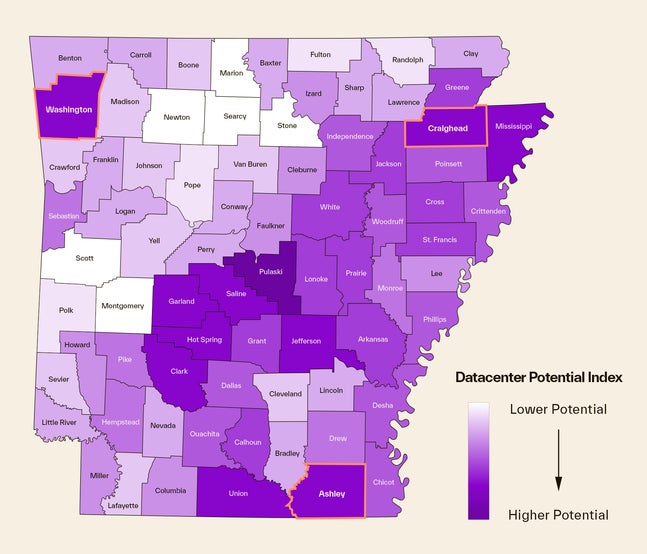
Source: Cotality data, 2026.1
The influx of massive AI data center investments is transforming the state of Arkansas into an attractive tech hub, shifting historical migration patterns. From 2022 to 2024, Arkansas averaged nearly 84,000 new residents, growing nearly 6% from the pre-pandemic average between 2017 and 2019. But even this small bump in population is moving housing prices. As more people moved in, property values rose to historic highs. Since 2024, home prices in the Little Rock metro area increased by 8.1%, according to Cotality data.
“When billions in tech investments land in a region, they bring a high-earning workforce that directly affects local housing supply. We’re seeing it happen in real time in cities like San Francisco, California which has pushed home prices up by 13% over the past year,” says Cotality’s Chief Economist, Dr. Selma Hepp. “The surge in price appreciation is the direct result of digital infrastructure rapidly materializing into physical real estate demand.”
Arkansas represents the ideal version of the AI opportunity. But the flood of labor, zoning accommodations, and resource requirements that enrich these towns can just as quickly strain them.
The tipping point
This tug-of-war is also playing out in Texas; a state long considered a prime example of cost-effective expansion. Tech giants are capitalizing on flexible local zoning rules by building private fiber networks across open land. This includes Google’s $40 billion investment in the state’s panhandle and Meta’s expansion in Fort Worth.
Cotality analysis has found that Kyle and Arlington, Texas, display the hallmarks of areas primed for data center development, based on available land, growth activities, and proximity to required infrastructure assets such as energy, communications, and water to support these massive campuses.
Yet, under the surface, the state’s physical infrastructure is beginning to buckle, illustrating what happens when growth outpaces a region's capacity.
The independent Texas grid (ERCOT) is currently facing demand for 194 gigawatts of additional power, more than double its existing capacity. And while land is plentiful, only a fraction is connected to fiber networks.
Add to that a 14-point drop in trust of the technology, the growing calls for regulatory scrutiny, and the state's elevated natural catastrophe risk, and the growth is something that must be navigated carefully.
“The future of data centers is cutting across party lines,” says Cotality’s EVP of Policy Pete Carroll. “Resource concerns are colliding with affordability anxiety, but equilibrium is possible. People need to trust that technology will serve everyone, and investments must consider impact with the same rigor as feasibility.”
Abilene, Texas is currently walking this tightrope. The city is home to a new 1,200-megawatt AI data center campus that is attracting a wave of newcomers into West Texas.
As buyers move into new build homes almost as fast as they are constructed, housing prices in this small Texas town stand in sharp contrast to the broader state. Cotality analysis has found that Abilene home prices have surged 19.7% since 2022, while rents have risen 33%. However, statewide, prices have dipped by –3.1%.

As Abilene’s housing costs rise, so too does its natural hazard risk. The metro area holds nearly $15 billion in reconstruction cost value, as residential properties face a triple-threat risk from tornadoes, hail, and wildfires.
"Right now, city planners build a data center and react to the subsequent rent spike," explains Cotality’s Head of Data Science, Amy Gromowski. "But by using predictive urban modeling, city planners can use data to precisely map out the necessary housing and transit footprints required to support an incoming workforce before an affordability crisis hits."
This relentless demand for space, power, and workforce housing is forcing a strategic global reevaluation.

The limits of expansion
The race to scale AI infrastructure has gone global, and international markets are hitting the same physical walls where planning and infrastructure fail to align.
Across the United Kingdom, data centers—which the government has designated as critical national infrastructure—are putting identical pressure on local communities.
Cotality has found that the map being drawn across the UK is defined by high digital infrastructure demand but constrained power grids. In the Slough and West London Corridor—Europe’s largest data center market—grid constraints have stalled new housing and industrial developments.
This bottleneck is forcing tech giants to invest billions to expand into less-developed areas outside London, such as Blythe, near Newcastle upon Tyne, and Newport in Wales. But bypassing borders for power comes with steep financial and environmental costs, including building expensive connections to national power lines and managing heightened windstorm risks along coastal areas.
Cotality data also shows that in coastal areas like Newcastle upon Tyne and Blythe, the wind risk exposure around new building sites means developers will likely need to rely on underground connections to shelter infrastructure from windstorms, which can further inflate costs. When adding the increasing price of materials, it has become clear that it will pay dividends to fortify these major investments for a resilient future.
Yet, building costs represent only one variable. Community costs carry far more weight. As data centers push further into protected areas and residential backyards, they are triggering local backlash and legal battles.
Technical feasibility cannot supplant local acceptance. At the core of AI’s physical expansion is a profound tension between institutional investment and public trust. AI technologies captured 61% of global venture capital in 2025, totaling a $258.7 billion pipeline. But this institutional confidence masks a reality: everyday consumer trust in the technology itself is wavering.
The trust cliff
In a recent Cotality survey, we found that 55% of homebuyers now use generative AI tools at least once a month, and 75% of homebuyers already assume AI is integrated into homebuying platforms and processes. But behind this widespread acceptance, we found a distinct drop in consumer confidence—people’s trust that AI will help them find a home dropped 14 percentage points over the last year.
Buyers are looking for help as they navigate the homebuying process amid a growing array of AI-driven services.
“Digital tools have streamlined the exploration of home options,” explains Gromowski. “But as you begin to seriously consider one of the largest financial and emotional transactions of your life, you need a trusted partner. You’re looking for someone who helps you understand with confidence, and that’s not 100% coming from a machine, not yet.”
This growing skepticism among everyday buyers creates a critical blind spot for tech giants. If consumers lose faith in the digital value of AI, their tolerance for its physical disruption — strained power grids, corporate-bought housing, and rising rents — will vanish.
Public backlash quickly translates into strict zoning laws, community resistance, and legal hurdles. If left unchecked, this consumer distrust will trigger regulatory delays that directly freeze the physical expansion efforts of the very data center companies driving the boom.
The new map of AI infrastructure
The rise of data centers has fundamentally rewritten the rules of technology and real estate. Massive financial investments are more than just scaling software; they’re actively reshaping local economies, shifting housing markets, and straining community resources from the UK to Arkansas.
The race to build AI infrastructure will be judged in megawatts, acres, rents, risk exposure, and local consent. The cloud now has a footprint. Communities will decide how much of it they are willing to carry.
1 Distance to power infrastructure (electric substations, power generation, energy storage, electric transmission lines), distance to telecommunication infrastructure (fiber optic cables, data centers), distance to bodies of water 20+ Acres of agricultural or vacant land.
© 2026 Cotality. All rights reserved. While all of the content and information is believed to be accurate, the content and information is provided by Cotality “as is” with no guarantee, representation, or warranty, express or implied, of any kind including but not limited to as to the merchantability, non-infringement of intellectual property rights, completeness, accuracy, applicability, or fitness, in connection with the content or information or product and Cotality assumes no responsibility or liability whatsoever for the content or information or product or any reliance thereon. Cotality™, the Cotality logo, and Intelligence beyond bounds™ are the trademarks of CoreLogic, Inc. d/b/a Cotality or its affiliates or subsidiaries. All other trademarks are the property of their respective owners.