


The Wildfire Suite for Holistic Catastrophe Risk Management


Overview
Modern catastrophe risk management requires a focus shift from historical data to simulation-based modeling and straightforward property-level scoring. Cotality™’s Wildfire Suite—including the U.S. Wildfire Model and the Wildfire Conflagration Score—assesses all nuances of risk today. By combining property intelligence with weather event simulations, these tools empower carriers to pursue proactive, granular underwriting.
The last decade has brought a surge of destructive wildfires to the United States. At the very start of 2025, the Palisades and Eaton fires destroyed more than 10,000 homes in the Los Angeles area. While California leads the nation in wildfire-related losses, the Golden State isn’t the only focus of this shifting peril: 11 of the most 20 destructive fires in Colorado’s history have occurred in just the last eight years.
The nature of these events demands that insurers, reinsurers, and stakeholders everywhere look beyond traditional methods for assessing wildfire risk management. To protect both policyholders and portfolios, the industry must commit to simulation-based modeling that captures the many nuances of the modern wildfire landscape.
What are simulation models for catastrophe risk management?
Simulation-based wildfire models provide the modern alternative to historical data as a risk management strategy. For insurers and reinsurers, relying solely on past occurrences can lead to catastrophic oversights; previous fire boundaries no longer dictate future behavior.
While historical data still has a place in laying part of the foundation for risk assessment, simulation models provide a necessary forward-looking vantage point that deepens our understanding of risk. Through stochastic modeling, these tools account for random variations in inputs over time, allowing insurers to quantify the probability of diverse outcomes under shifting conditions.
Simulation catastrophe modeling provides a virtual laboratory, running thousands of randomized weather and ignition scenarios to see how frequent and severe a fire could become.
The value of this approach becomes clear when looking back at the 2017 Tubbs Fire of Santa Rosa, California, and the 2018 Camp Fire of Paradise, California. Ahead of these fires, carriers who exclusively used historical data for catastrophe risk management would have been blindsided; neither of those Northern California regions had a single recorded fire of that magnitude in their history.
Why have wildfires increased in recent years?
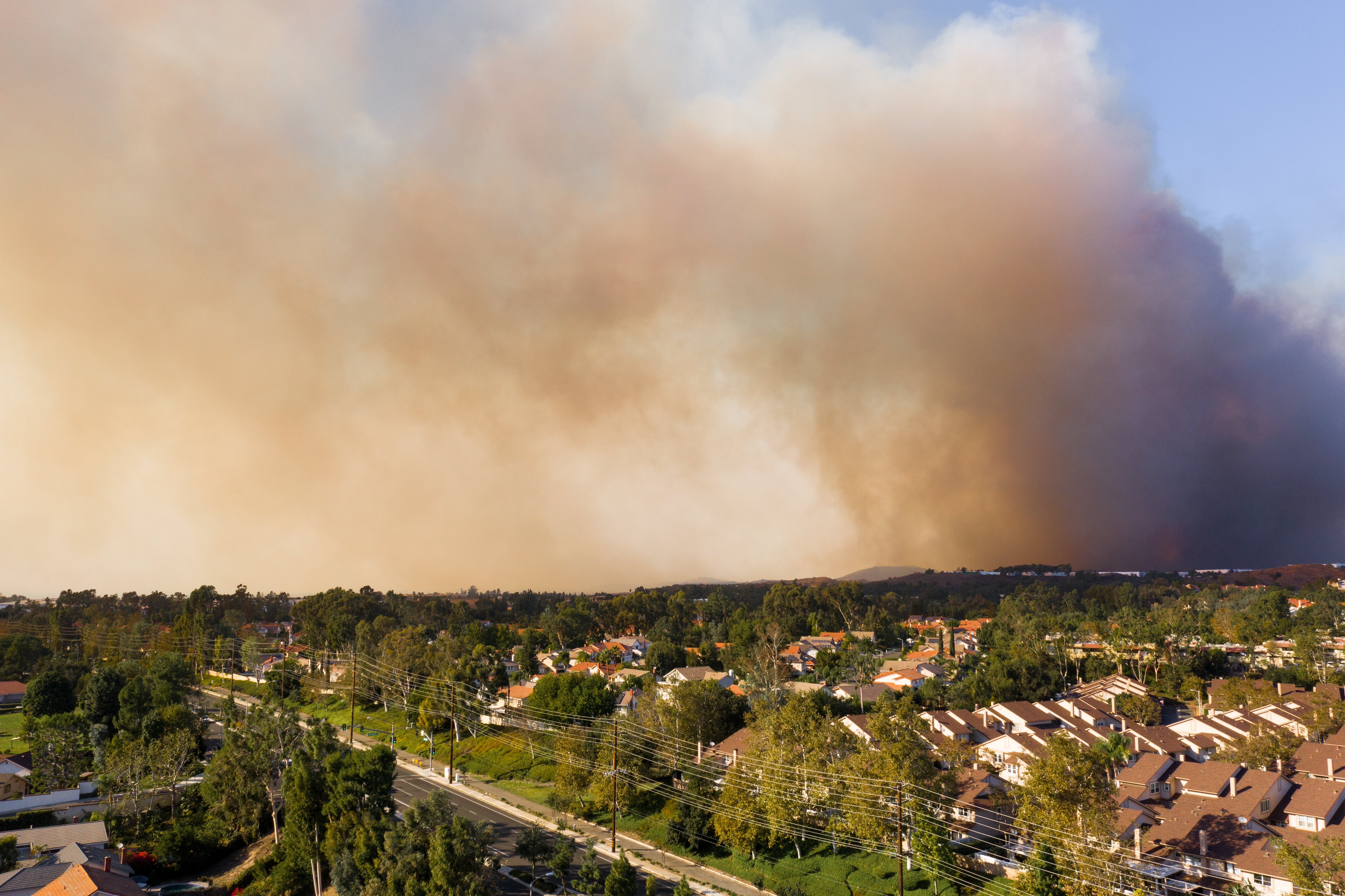
The primary driver of more disastrous blazes has been the transition of wildfires to conflagrations, as seen with the 2025 Los Angeles wildfires. This shift is vital for insurers to grasp, as these events become increasingly common with human development expanding closer to fire-prone natural landscapes.
A wildfire is an uncontrollable fire fueled primarily by natural vegetation in wildlands, whereas a conflagration occurs when that fire moves into the built environment and spreads from building to building. This transition marks the point when structures evolve
into the primary fuel source, not the vegetation that may have started the fire. The definition of the Wildland-Urban Interface (WUI) is the zone where human-made structures meet or intermingle with undeveloped wildland. As it expands, a property may have low "natural" wildfire risk while being at high risk for conflagration.
This reality demands that insurers use conflagration-specific tools alongside traditional catastrophe risk modeling.
All the ingredients for a comprehensive wildfire risk management strategy
Insurers require sophisticated, simulation-based tools that capture the full spectrum of wildfire risk—from regional hazard and conflagration potential to individual property mitigation.
Cotality delivers these capabilities through the Wildfire Suite, offering five models to quantify risk at the property level:
- The Wildfire Risk Score™ Cotality’s flagship wildfire risk scoring model enables underwriters to more accurately differentiate between high- and low-risk areas. By synthesizing data on fuel, topography, and climate (wind and drought),this scoring model delivers property-specific scores on a 5–100 scale that provides easier-to-understand, critical insight into the natural wildfire hazard before the built environment or specific mitigation measures are considered.
- The Wildfire Conflagration Score™ This model measures the threat of wildfires transitioning from vegetation to structure-to-structure fires. Also on a 1-100 scale, it evaluates building density, structure characteristics, wind direction, and ember components to identify properties at risk of loss in a mass-fire event.
- The Wildfire Mitigation Score™ This California-specific model enables insurers and lenders to comply with the California Department Insurance (CDI) requirement that mitigation be factored into risk assessment and pricing. The model quantifies property-level resilience, specifically evaluating "home hardening" measures—such as non-combustible building materials—and the maintenance of defensible space.
- The U.S. Wildfire Model Cotality’s U.S. Wildfire Model is a probabilistic catastrophe model that uses thousands of computer simulations to estimate the financial impact of wildfires. By integrating historical patterns with forward-looking simulations, this model excels at evaluating portfolio-level volatility, Average Annual Loss (AAL), and exceedance probability. This model also delivers deeper insights into wildfire risk scores.
- Cotality Wildfire™ The newest component to the suite, Cotality Wildfire is a comprehensive, structure-level assessment suite that integrates the traditional hazards of wildfires with structure-to-structure fire spread. It combines Cotality’s flagship Wildfire Risk Score with Cotality’s Wildfire Conflagration Score to generate the Cotality Wildfire Score, a single composite metric that provides a unified view of the total risk profile for any given location.
Note on model integrity: To ensure scientific rigor, Cotality uses entirely separate datasets for model development and validation. This process eliminates bias and increases the long-term efficacy and accuracy of all outputs.
Cotality provides the full view of wildfire risk
As climate conditions and urban expansion redefine the wildfire peril, your catastrophe risk management strategy must evolve accordingly.
By utilizing Cotality’s full suite of simulation-driven solutions, insurers gain the increased clarity they need to offer sustainable coverage and foster more resilient communities.
Learn more about Cotality’s Wildfire Suite today.