


Scale Without the Chaos: How Connected Data Powers Every Stage of Restoration Growth


Every restoration business inevitably hits a breaking point where the manual processes that once kept the lights on begin to hinder its growth. Whether you are an independent startup tracking receipts in a truck or a multi-state franchise trying to consolidate labor costs, the underlying challenge is identical: fragmented data leads to operational chaos.
To understand how restoration companies successfully navigate these growing pains, we looked at three distinct operations at different stages of their business lifecycle. While their specific daily hurdles varied, they shared a similar blueprint for success: abandoning tedious workflows in favor of a single, interconnected digital ecosystem.
Here is how establishing a single source of truth empowers restoration businesses to evolve and scale at every stage of their journey.
Stage 1: Establishing Baseline Visibility and Protecting Margins
For an up-and-coming and fast-growing restoration business, the biggest hurdle is often keeping track of the moving parts to ensure profitability. Murphy Cravens launched Cap Edge Construction in Southern California in 2021, operating an independent company that handles 80% reconstruction work. Because reconstruction involves high upfront costs and long payment cycles, tracking cash flow is critical.
Early on, however, managing that cash flow meant wrestling with a chaotic mix of Microsoft OneNote, Excel spreadsheets, and calculators.
The transition to Cotality’s DASH™ platform in 2023 provided the immediate financial visibility Cap Edge needed to confidently manage their growth. By integrating DASH directly with QuickBooks, Murphy no longer had to manually figure out which receipts belonged to which jobs. Instead, his team gained real-time, instantaneous reports on job costs and accounts receivable, allowing them to pinpoint exactly where they were short on money and where they needed to focus their efforts to collect.
This newfound internal clarity has also naturally translated into stronger external partnerships. For independent contractors, maintaining positive relationships with insurance carriers is just as important as the physical restoration work. Transparency builds trust, and having a comprehensive, centralized record of a job's entire lifecycle makes it easy to keep insurance carriers informed and aligned.
This level of transparency pays off the most when complex reconstruction projects face inevitable delays. When a job stalls, carriers immediately start scrutinizing the timeline because the Additional Living Expenses (ALE) of housing displaced policyholders can mount rapidly.
Today, the Capital Edge team no longer has to scramble for answers. They simply point to their system of record — a single source of truth enabled by DASH, the command center of all their progress. By letting the data tell the story, Murphy and his team have been able to protect their profit margins while positioning their business as a reliable, professional partner to every carrier they work with.
Stage 2: Standardizing the Field for Unshakeable Quality Control
Once a business establishes financial visibility, the next operational hurdle becomes quality control. How do you trust the data coming from your technicians?
For David Breen, Owner and President of Rainbow Restoration of Shoreview, the problem wasn't a lack of effort from his team; it was a lack of structure. Despite bringing 25 years of firefighting and insurance adjusting experience to the franchise, David Breen found the operation hindered by handwritten field notes, scattered information, and documentation quality that varied wildly depending on a technician's workload. This inconsistency led to delays, rework, and frustrated adjusters.
Breen realized that “you can scale systems, you don’t want to scale chaos”. By leaning into Cotality's naturally interconnected solutions — specifically utilizing DASH Compliance Tasks to guide workflows within Mitigate™ — Rainbow Restoration removed the guesswork from daily routines.
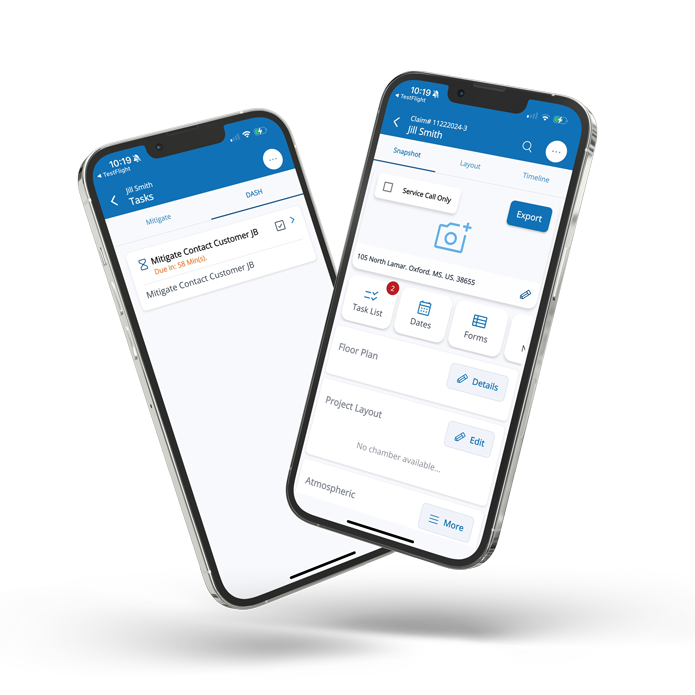
Mitigate actively guides field teams through data collection on the job site, ensuring that critical moisture readings and photos are captured correctly the first time. Because the systems are seamlessly connected, information is entered once and flows directly to the office, eliminating the need for manual reentry.
This workflow improvement has completely transformed Shoreview's cycle times. Estimates are submitted sooner, questions from adjusters are reduced, and David can confidently delegate tasks without constantly double-checking files for missing details.
Stage 3: Leveraging Macro-Level Insights for Multi-State Expansion
When data becomes standardized and a company begins to expand rapidly across state lines, the challenge shifts from managing individual jobs to managing macro-level trends. Relying on intuition or manual folder audits is no longer physically possible.
When Cody Michael joined ServPro Team Miller in 2016, the Detroit office had just two employees. Today, as Chief Operating Officer, he oversees 34 franchise licenses across four states, driving nearly $70 million in revenue.

$70M
Annual Revenue
Achieving a 3x increase over 8 years
17x
Franchise Growth
From 2 to 34 Licenses Across 4 States
20-30%
Increased Capacity
Streamlined Through Workflow Auomation
10%
Profitability
Driven by Job Cost Auditing
Before adopting a unified operational system, finding something as simple as a gross margin meant pulling timesheets from QuickBooks, cross-referencing paper invoices, and doing calculations on physical job folders. "If I wanted access to all of that data at one time, I would have to access three different systems to get it," Cody explains.
Moving their entire workflow to DASH provided the foundation ServPro Team Miller needed to sustainably scale. By utilizing features like DASH Timesheets, Cody’s team can pull time usage across multiple markets to identify labor leakage and automate overtime tracking before it spirals out of control.
Instead of manipulating spreadsheets to calculate weekly metrics, the DASH Business Intelligence (BI) tool saves their team weeks of administrative labor every year. This live, granular data dictates exactly when the company needs to hire new project managers, when to buy new fleet vehicles, and which referral sources are yielding the highest returns in specific new markets.
A Shared Truth for the Restoration Industry
While Capital Edge Construction, Rainbow Restoration of Shoreview, and ServPro Team Miller operate at entirely different scales, their individual journeys reveal a shared truth about the restoration industry. Relying on disconnected tools forces your team to work through chaos rather than focusing on the work.
Simply put, fragmented software fundamentally limits a business's potential. As Cody Michael points out, “when you're using multiple systems, you end up duplicating efforts and you can't trust either system to hold the whole truth.”
Overcoming this lack of trust requires a unified digital foundation. As David Breen explains, the long-term value of this approach is that “as volume increases or processes evolve, we’re not constantly reinventing how systems talk to each other. The foundation is already there — to help support better decision-making and more efficient operations.”
By embracing a complete, interconnected operational ecosystem, restoration businesses of any size can stop managing disparate and tedious methods and start confidently scaling their legacy.
Cotality Restoration features mentioned in these case studies:
- DASH™ – Restoration command center for complete job management, real-time financial visibility, and workflow automation.
- Mitigate™ – Water mitigation documentation platform ensuring field accuracy and standardized data collection.
- DASH Business Intelligence (BI) – Advanced reporting and performance analytics providing macro-level insights for data-driven scaling.
Ready to stop managing fragmented software and start building a unified digital foundation? Learn more about how Cotality’s interconnected restoration solutions can eliminate operational chaos and accelerate your growth.

