


Press Release
National rent growth cools, but pressure remains on renters


U.S. single-family rent prices increased by 1.3% year over year in January 2026.
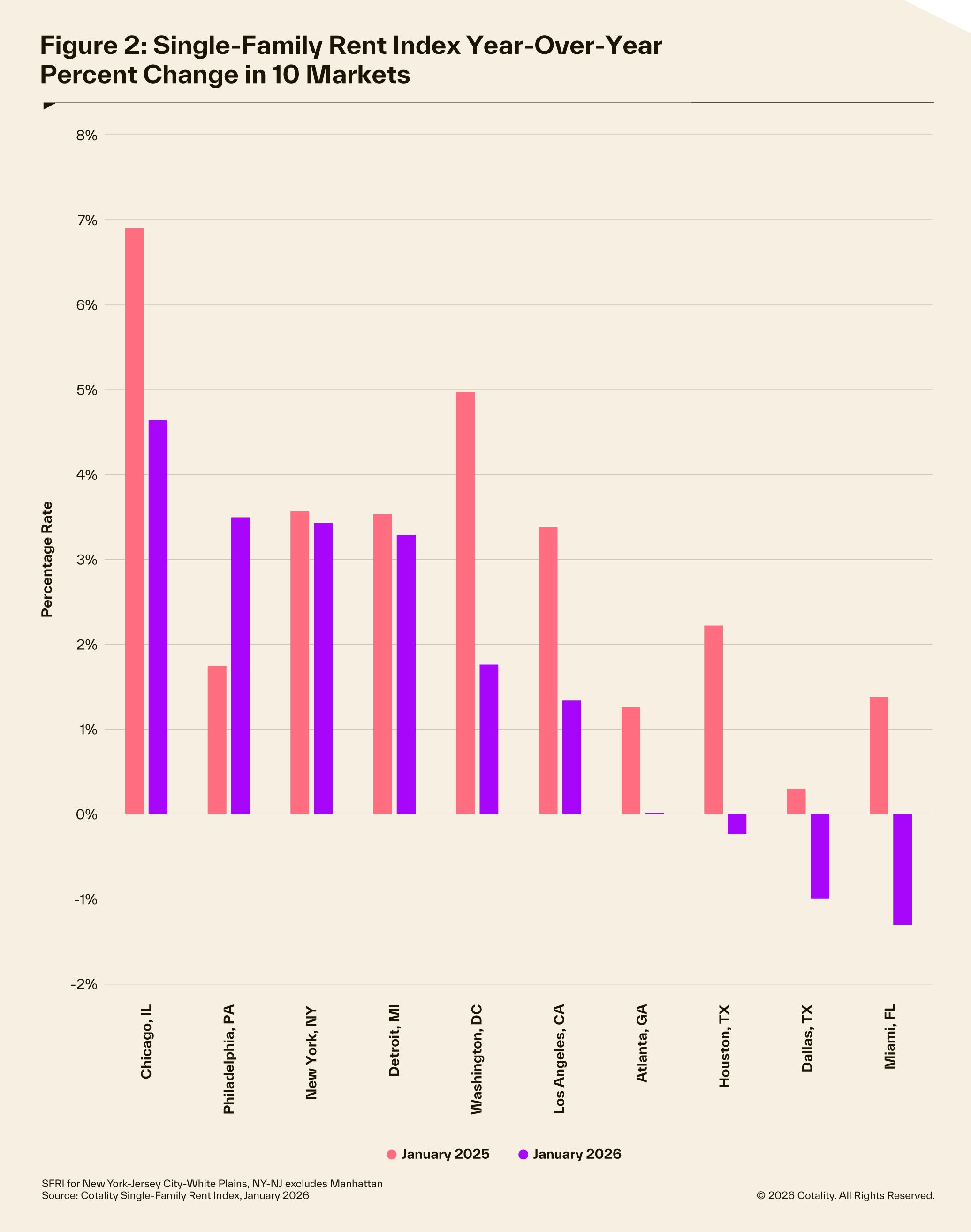
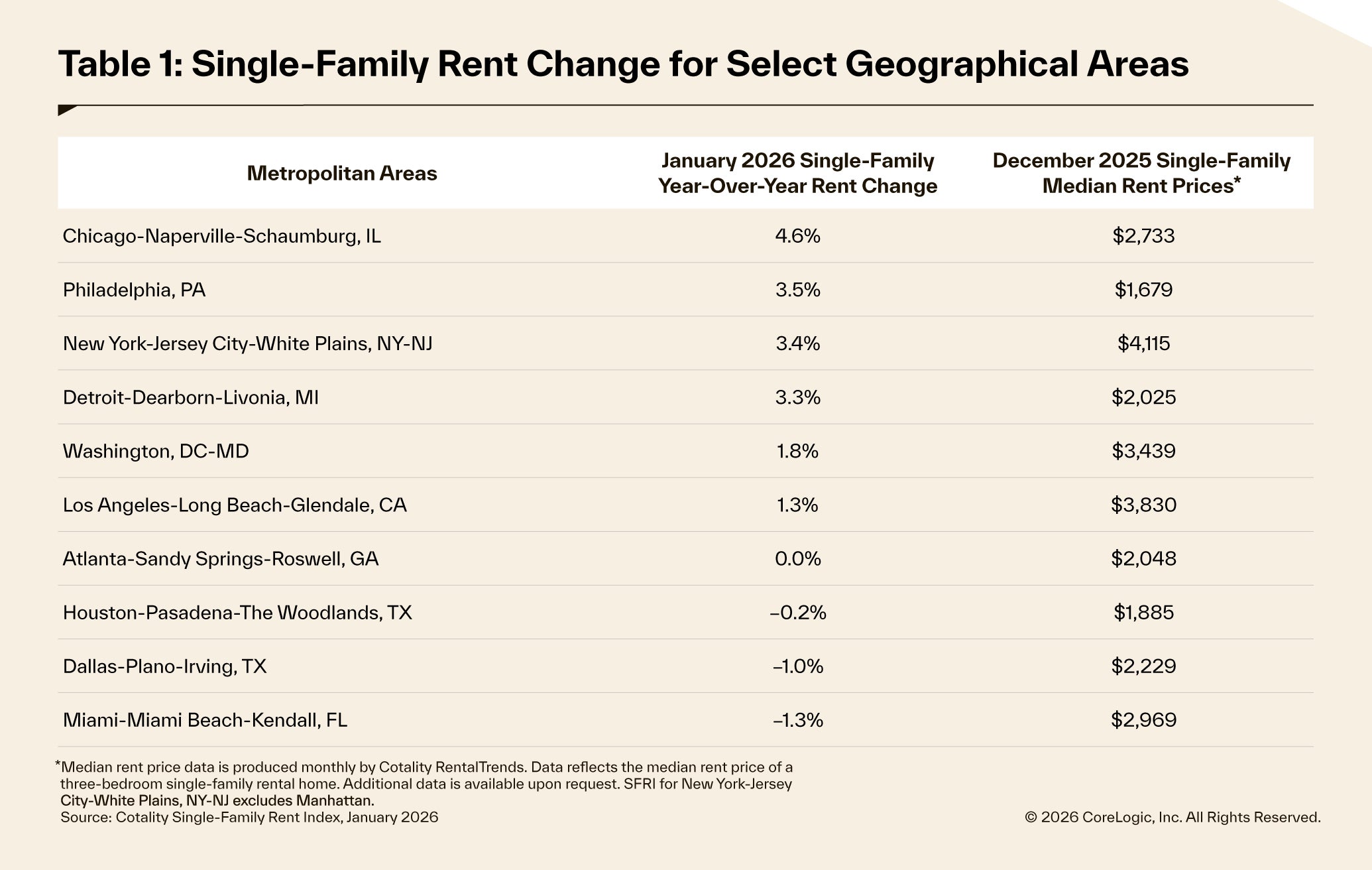
- Chicago (+4.6%) and Philadelphia (+3.5%) logged the strongest annual gains in single-family rents among major metros.
- Single-family rent growth cooled in 74% of metros, and 38% saw year-over-year declines.
- Florida accounted for about 40% of metros with falling annual rents.
IRVINE, Calif., March 19, 2026 – Cotality, a leading global property information, analytics, and data-enabled solutions provider, released its latest Single-Family Rent Index (SFRI) with January 2026 data, which analyzes single-family rent price changes nationally and across major metropolitan areas. Single-family rent prices in January 2026 increased by 1.3% year over year. This increase is a drop-off from the 2.5% increase we saw between January 2024 and 2025.
“Single-family rent growth continued to cool in January, rising just 1.3% year over year—half the pace recorded a year earlier and well below the long‑term average of 3.4%. Yet even with this moderation, affordability pressures remain elevated,” said Molly Boesel, senior principal economist at Cotality. ”Since 2020, rents have increased 32%, adding roughly $600 per month, and are still up 11%, about $300, after growth peaked in 2022. Regionally, markets such as Chicago and Philadelphia led national gains in January, while several Florida markets, including Miami, posted year‑over‑year declines. But even in Miami, where rent growth has softened or even decreased since 2023, cumulative increases have pushed single-family rents up 51%, or roughly $900 per month, since the end of 2019.”
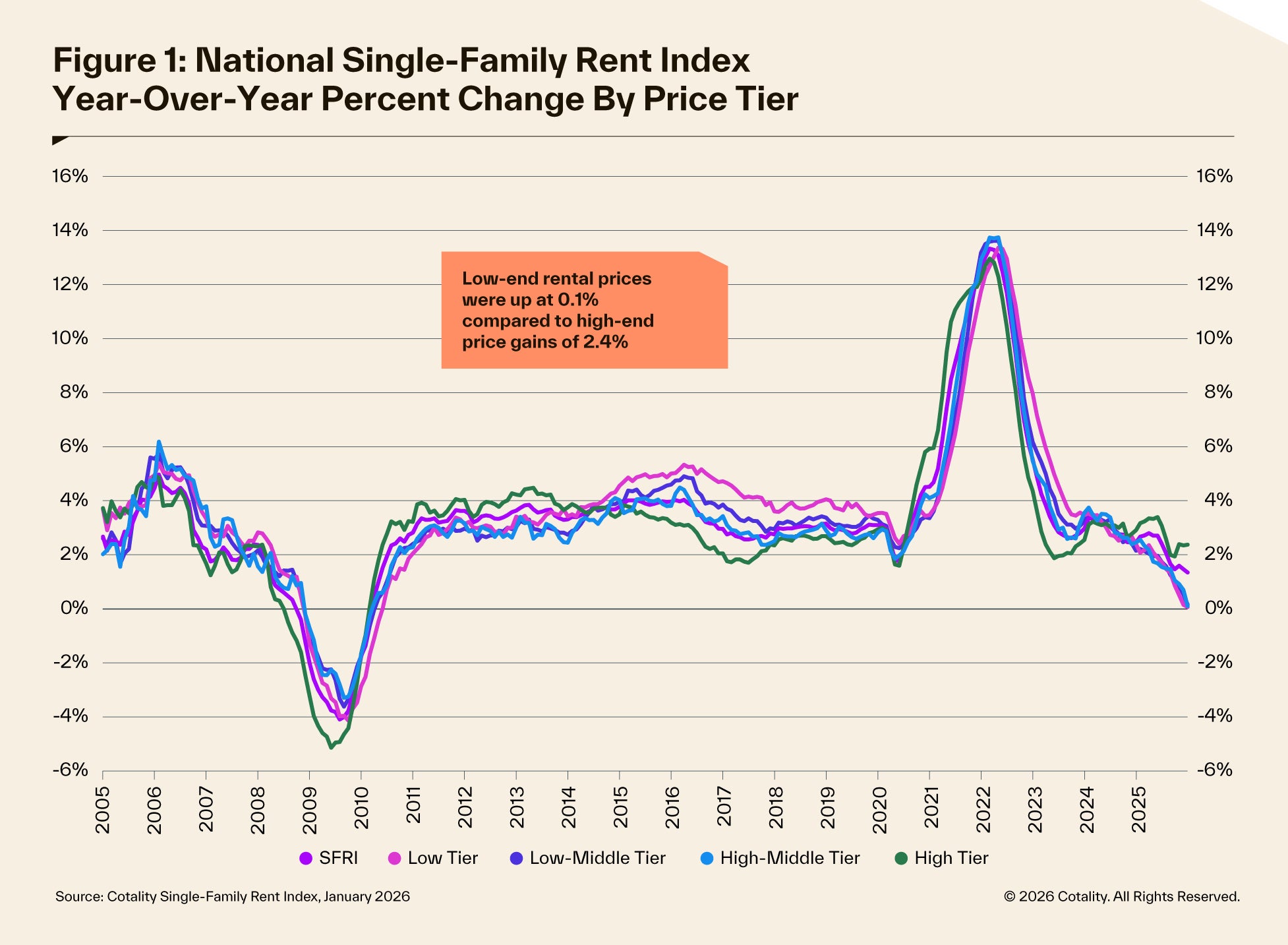
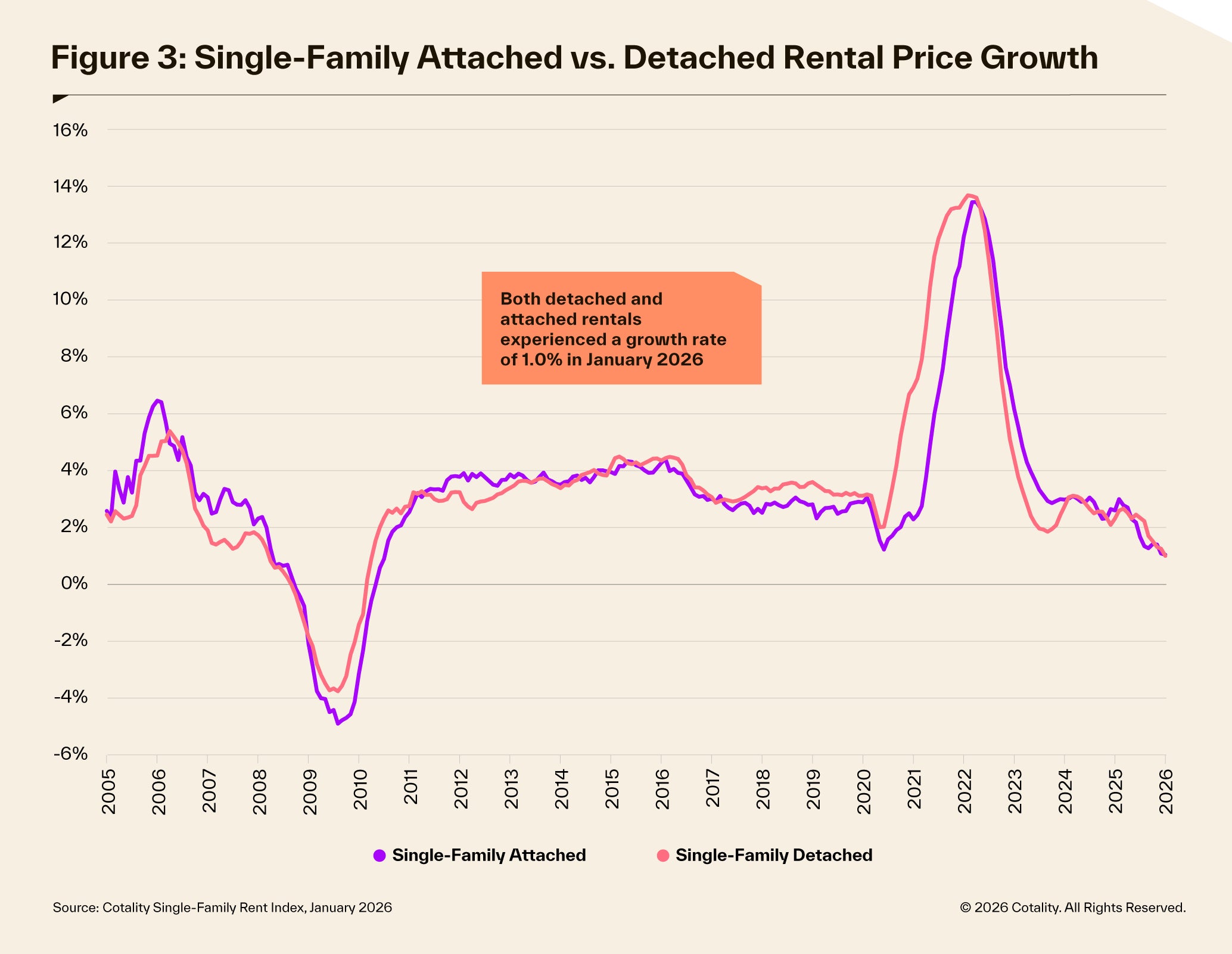
Single-family rent trends also varied by price tier. Rent for high-priced properties increased 2.4% year over year in January 2026, a drop from the 2.9% gain recorded in January 2025. Low-priced rents increased by 0.1% in January 2026, a drop from a 2.4% gain in January 2025. Over the long run, the increase in both price tiers has been similar. Rent growth for both detached and attached rentals was 1.0% in January 2026.
The slowdown in single-family rent growth continued to broaden in January. The share of metropolitan areas with weaker annual rent growth increased from 68% in December to 74% in January, and the share showing an annual decline in rents rose from 26% in December to 38% in January. Even so, Cotality data show regional increases trending the same way in January as in the last several months. Chicago remained at the top of the list for the highest rent growth, at 4.6% in January 2026. Philadelphia, PA, had the second-highest rent growth at 3.5%, followed by New York, NY (3.4%), Detroit, MI (3.3%), and Washington, DC (1.8%). Rent growth in Miami dropped the most significantly at -1.3%, followed by Dallas, TX (-1.0%) and Houston, TX (-0.2%).
The next Cotality Single-Family Rent Index will be released on April 16, featuring data for February 2026. For ongoing housing trends and data, visit the Cotality Insights blog: www.cotality.com/insights.
Methodology
The Cotality Single-Family Rent Index (SFRI) applies a repeat pairing methodology to single-family rental listing data in the Multiple Listing Service. The rental listings used to calculate the index include both attached and detached single-family homes, as well as condominiums. This report shows trends for the U.S. and the 10 largest U.S. metropolitan areas. In addition to these 10 metros, the Cotality SFRI is available for close to 100 metropolitan areas — including approximately 50 metros with four value tiers — and a national composite index. The indices are fully revised with each release to signal turning points sooner.
The Cotality Single-Family Rent Index analyzes data across four price tiers: Lower-priced, which represent rentals with prices 75% or below the regional median; lower-middle, 75% to 100% of the regional median; higher-middle, 100%-125% of the regional median; and higher-priced, 125% or more above the regional median.
Median rent price data is produced monthly by Cotality Rental Trends. Rental Trends is built on a database of more than 11 million rental properties (over 75% of all U.S. individually owned rental properties) and covers all 50 states and 17,500 ZIP codes.
About Cotality
Cotality accelerates data, insights, and workflows across the property ecosystem to enable industry professionals to surpass their ambitions and impact society. With billions of real-time data signals across the life cycle of a property, we unearth hidden risks and transformative opportunities for agents, lenders, carriers, and innovators. Get to know us at www.cotality.com.
Media Contact
Charity Head
Cotality
