Overview

Cotality Hazard HQ Command Central™ releases preliminary industry insured loss estimates for Storm Kristin utilizing newly available, validated wind gust observation data from various European meteorological agencies.
- Portugal insured loss estimate range: 300 million EUR – 450 million EUR
- Spain insured loss estimate range: 40 million EUR – 100 million EUR
This estimate represents insured losses from wind damage to buildings, contents, and business interruption to residential, commercial, industrial, and agricultural properties across the Iberian Peninsula. (Localised flooding and landslides are not included).
Meteorological details
Kristin is the 26th named storm of the 2025–2026 season and the 11th named by the southwestern group of European countries. While the storm hit Portugal the hardest, it also impacted Spain, Italy, and Greece.
"Status Red" warnings of hurricane-force winds were issued by both the Portuguese Institute for Sea and Atmosphere (IMPA) and the Spanish State Meteorological Agency (AEMET). The National Emergency and Civil Protection Authority elevated Portugal to the highest level of mobilization 24 hours before landfall.
Kristin formed as a secondary low on Tuesday, Jan. 27, and reached a minimum central pressure of 975mb. Analysis suggests that the storm may have developed a sting jet — a localized area of very strong gusts — before landfall in Portugal in the early hours of Wednesday, Jan. 28.
Strong gusts were observed in Coimbra and Leiria municipalities, with a record-breaking 130 mph measured in Soure, Coimbra. In Leiria, gusts of 109 mph at the Monte Real airbase and 97 mph at the Leiria aerodrome were recorded. Kristin continued to track eastwards and weakened relatively quickly, dissipating on Jan. 31.
The Impact
The Centro region of Portugal was most impacted by the storm, where the districts of Leiria, Coimbra, Castelo Branco, Santarém, and Portalegre experienced high gust windspeeds. There were also high levels of precipitation in Lisbon and Setúbal districts, leading to localized flooding.
There are reports of property damage due to strong gust winds across the district of Leiria, an area known for plastic and metal industry activities. Examples of the damage include the partial destruction of the municipal sports center in Leiria, damage to F-16 jets at the Monte Real air base near Leiria, and widespread reports of damage to large roofed buildings such as churches, factories, and schools across the area. Additionally, there was significant damage to the Leiria National Forest.
Critical transport infrastructure was severely interrupted in the affected areas in addition to widespread power outages affecting nearly 1M customers across Portugal. Approximately 10% of the population were affected. As the storm tracked east and south across southern Spain, there were over 150,000 properties affected by power outages in Andalucia.
Storm Kristin is the most damaging wind event since ex-hurricane Leslie struck western Portugal in 2018 and is expected to surpass those levels of economic and insured losses. Earlier this week, the Portuguese government approved an emergency funding package of loans and incentives up to 2.5 billion EUR to assist and expedite householder and business recovery. With flooding from Storm Leonardo closely following Kristin, the total economic damage from the storms could be in the 3B EUR – 4B EUR range.
A cluster of storms
While Storm Kristin is the most damaging wind event since ex-hurricane Leslie struck western Portugal in 2018, it occurred as part of a series—or cluster—of storms that plagued the Iberian Peninsula in late January (Storms Harry, Ingrid, Joseph, and Kristin) and early February 2026 (Storms Leonardo and Marta).
This cluster of storms caused accumulated precipitation, which led to intense, widespread flooding and associated damage. Although Kristin dominated wind losses, such clustering can lead to severe aggregate losses. For example, in 1990, four storms each caused a loss of more than 1 billion EUR in Northern Europe. Similarly, in December 1999, three successive storms—Anatol, Lothar, and Martin—each caused a loss of at least 2 billion EUR, impacting France, the Low Countries, and Denmark.
Antecedent conditions — what caused this clustering?
A large-scale anticyclonic “blocking” pattern in the atmospheric pressure field located between Greenland and Scandinavia drove this series of Iberian storms. This led to the jet stream—which determines the tracks of windstorms—moving southward, making storms more likely to impact Southern Europe.
The North Atlantic Oscillation (NAO)
The North Atlantic oscillation (NAO) is the primary source of natural variability affecting European windstorm risk. This large-scale atmospheric oscillation manifests itself as the seesaw of pressure anomaly difference between the Azores High and Iceland Low. Its positive phase tends to be marked by a poleward shift of storm tracks over Europe, and its negative phase is marked by a southward shift.
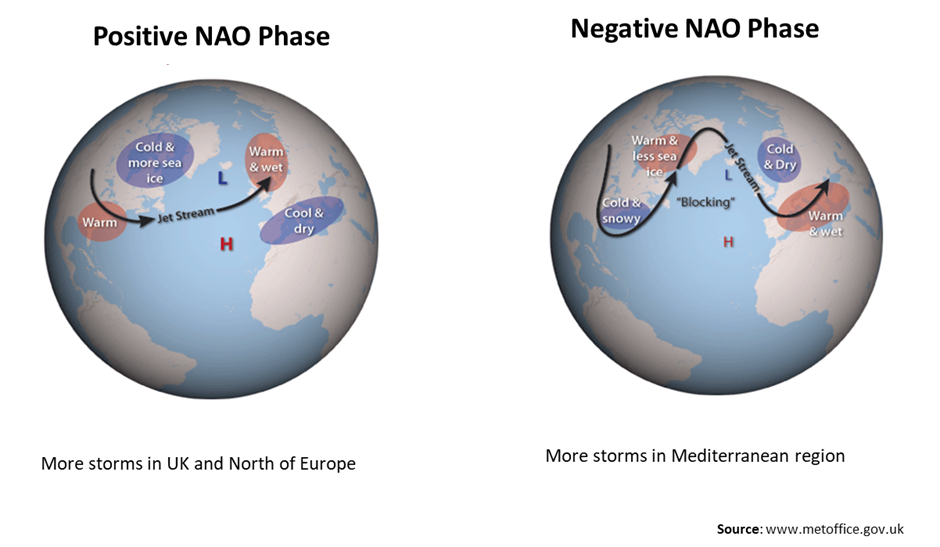
Figure 1: Phases of the North Atlantic Oscillation. Source: The Met Office UK
During January 2026, the NAO was in a negative phase, according to the National Centers for Environmental Information, leading to the series of Iberian storms.
In Cotality’s European Windstorm model, the default analytical stochastic event set spans the positive, negative, and neutral phases of the NAO. However, users can determine the impact of the NAO phase on modeled losses by choosing to run the additional stochastic event sets corresponding to the positive and negative phases of the NAO. These sets consist of events that have been translated in latitude and altered in strength to match the impact of NAO as detected in a 1,200-year-long Earth System Model. The storm footprints are physically different from the analytical model to provide a realistic representation of the NAO phase in both severity and frequency.
Importantly, the likelihood of obtaining a loss equivalent to that of Storm Kristin increases when using the NAO negative phase set, as a greater number of intense storms tend to make landfall in Iberia
Cotality will continue to monitor the situation and provide updates when available.