Overview

Update: 27 October 2026
Storm Boelo hits Scotland and Ireland
The U.K. Met Office named Storm Boelo on Thursday 22 October, the second named storm on this season's list. Boelo passed northwest of Ireland and over northern Scotland on Saturday 24 and Sunday 25 October, before moving toward Norway. It reached a central pressure of 945 hectopascals, deeper than Storm Austen.
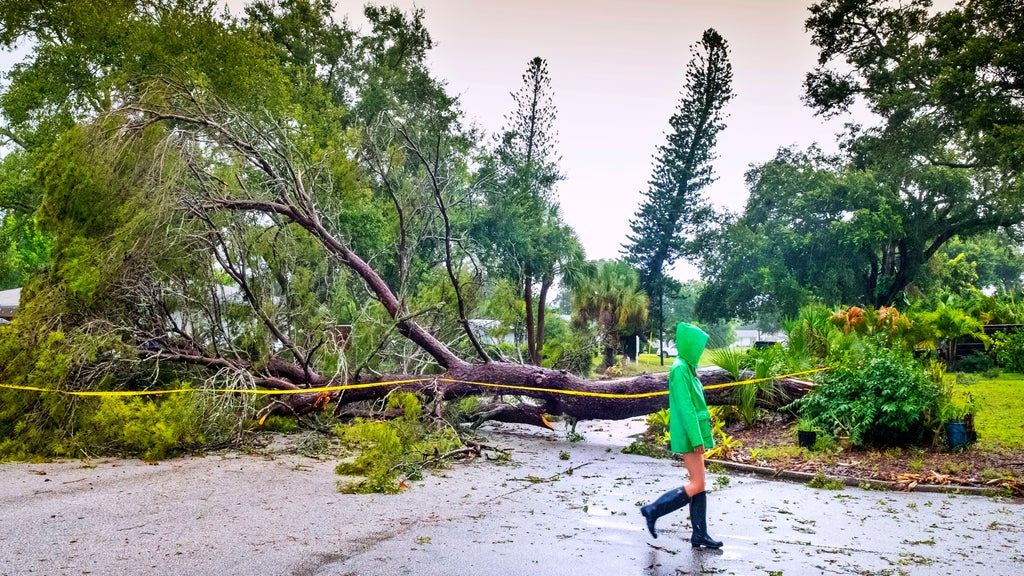
The strongest gusts hit western Scotland, where Machrihanish recorded 84 mph. More than 100,000 homes in Scotland lost power. In Ireland, thousands of customers lost power as fallen trees and debris cut power lines in rural areas. Boelo also brought a minor storm surge to the German coast.
Why two storms arrived so close together
Atlantic storms are steered and strengthened by the jet stream, a fast-moving river of air about 10 kilometers above the surface. Austen and Boelo developed one behind the other along the jet stream and were sent toward the U.K. in quick succession. A brief ridge of high pressure between them brought a lull in the winds on Friday night and Saturday morning.
The pattern itself is not unusual. Storms in quick succession are a well-documented feature of the European windstorm season. In February 2022, for example, storms Dudley, Eunice and Franklin all hit the U.K. within a week.
Clusters of very strong storms are rarer. Examples include early 1990, with the Burns' Day Storm, Vivian and Wiebke, and December 1999, with Anatol, Lothar and Martin. Austen and Boelo had far smaller consequences than those events. Boelo was the deeper of the two, but its damage so far points to widespread disruption rather than the large-scale structural losses seen in those earlier clusters. Had Boelo tracked farther south, it would have hit the densely populated areas around Glasgow and Edinburgh.
What this means for insurers
For insurers, the key issue with a cluster of storms is accumulation, because claims, repairs and restoration work overlap. Boelo's footprint was farther north and west than Austen's. Its heaviest impacts were in western Scotland, Ireland and Northern Ireland, where power outages and transport disruption were the main consequences. Ireland, parts of England and Wales, the Netherlands, Belgium and Germany felt both storms.
Cotality continues to monitor damage reports and will provide updates on storms Austen and Boelo when available.
Update: 23 October 2026
Storm Austen, the first named storm of the 2026-2027 European windstorm season, swept across southern Britain and northern France on Friday 23 October. It brought gusts of up to 100 mph and cut power to hundreds of thousands of customers.
The U.K. Met Office named the storm on Tuesday 20 October, the first name on this season's list for the United Kingdom, Ireland and the Netherlands. The low crossed southern Britain and northern France on Friday and reached the Low Countries by late morning, with a central pressure of around 974 hectopascals.
Strongest winds hit Brittany and southwest England
The strongest gusts struck the coast of Brittany. Gusts reached 100 mph at Pointe du Raz in Finistère and 93 mph on Île de Groix. Météo-France placed more than 20 departments under orange warnings.
In the U.K., the Met Office issued an amber wind warning for Cornwall, the Isles of Scilly and parts of west Devon, with yellow warnings across much of England and Wales. Gusts reached 76 mph at St. Mary's Airport in the Isles of Scilly, 74 mph at Aberporth in Wales and 71 mph at Culdrose in Cornwall.
Heavy rain also brought flooding to parts of England, including roads in north Staffordshire, and the Environment Agency issued flood warnings across several regions.
Widespread power outages and travel disruption
France saw the largest impacts. More than 280,000 customers lost power in the northwest of the country. Three Normandy bridges closed, and rail services were disrupted.
In the U.K., more than 9,000 homes lost power in Cornwall and Devon, and some flights and trains were canceled. Schools closed in parts of the southwest, and fallen trees blocked roads across Cornwall. In Brighton, part of the already derelict West Pier collapsed into the sea.
In Ireland, about 3,000 customers lost power, and fallen trees were reported in Waterford and Cork.
"Storm Austen, the first named storm of the season, has brought damaging gusts and widespread power cuts to north-west France and south-west England. We expect property damage to be relatively modest, spread across smaller claims, rather than catastrophic. Windstorms remain a risk, however, and have historically caused very large losses. The impact of Austen will become clearer in the coming days. With Storm Boelo also arriving on Saturday, further claims are expected over the weekend. Cotality will continue to monitor both storms," said Mark Dixon, senior weather scientist at Cotality.
Storm Boelo follows this weekend
A second storm is already on the way. Storm Boelo is forecast to bring strong winds to the north of the U.K. and Ireland this weekend.
The Met Office has issued an amber wind warning for much of Scotland, Northumberland, Cumbria and parts of Northern Ireland from 9 p.m. Saturday 24 October to 9 p.m. Sunday 25 October. Forecast gusts are 60 to 70 mph, and up to 80 mph on exposed coasts. Met Éireann has issued orange wind warnings for Donegal, Galway, Leitrim, Mayo and Sligo from 2 p.m. Saturday to 9 a.m. Sunday.
What this means for insurers
Austen's damage so far points to a typical early-season windstorm: fallen trees, roof and fence damage, and widespread outages rather than large-scale structural losses. The heaviest concentration of claims is likely to be in Brittany and Normandy, where the strongest gusts and most outages occurred.
Cotality continues to monitor damage reports and will provide updates on the impact of Storm Austen when available.